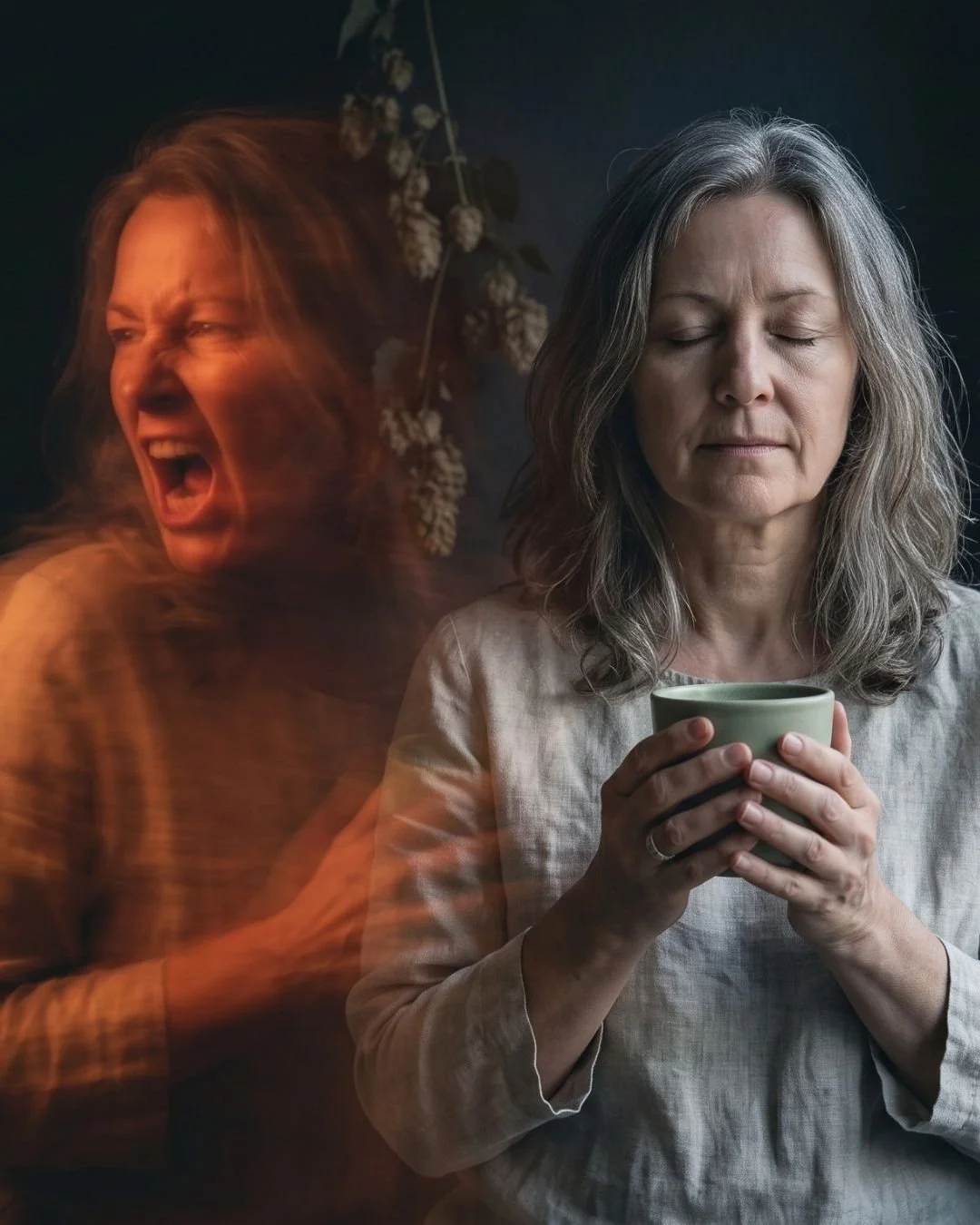
It sounds completely upside down, but for some of us, standard relaxing herbs don't bring peace—they bring pure, unfiltered adrenaline.
Many years ago, long before I ever trained as a medical herbalist, I was around eighteen or nineteen and navigating immense emotional swings. Back then, I didn't have the language or understanding I have today. I didn't know I was carrying CPTSD, that I was a Highly Sensitive Person (HSP), or that I likely moved through the world with a neurodivergent mind—most probably ADHD. I haven't pursued an official diagnostic pathway, largely because over the decades I’ve learned how to listen to and support my body (most of the time, anyway!), though it’s something I may explore down the line.
One evening, I was with a boyfriend, and an enormous wave of pure anger began rising in my chest. I couldn’t even tell you why. All I knew was the sheer intensity of the rage completely eclipsed the situation at hand - it simply didn't fit the moment.
Wanting to help, my boyfriend’s mum handed me a couple of little herbal tablets called ‘Kalms’.
Back then, the classic over-the-counter formula relied heavily on a blend of hops and valerian. Everyone knew Kalms; they were supposed to soothe your nerves, soften irritability, and help you breathe.
I took them. And within 20 minutes, I experienced an explosion of fury.
Instead of softening, my anger spiked into an overwhelming rage. I felt so consumed by these intense feelings that I wanted to bash my head against the wall, to self harm to bring relief. The only way through, without self harming, was to scream and sob at the top of my lungs until, completely depleted, the rage storm finally passed through sheer exhaustion. For me, those "Kalms" were literal Furies.
A similar pattern showed up at that time with beer. After just a single pint, I’d suddenly feel bristling, argumentative, and downright fighty—once or twice even squaring up to start physical fights with very large men, luckily for me they were kind and I was more an annoyance than an actual threat.
What on earth was going on?
Watch me share why calming herbs can leave sensitive nervous systems wired and furious, and the gentler allies that help instead.
Why Can Relaxing Herbs Make You Feel Worse?
Years later, during my clinical herbal training, an experienced teacher finally illuminated the puzzle.
For certain nervous systems, heavy sedative herbs like hops (Humulus lupulus) and valerian (Valeriana officinalis) feel entirely too heavy. If your brain is already working hard to stay present, or if your internal baseline requires a certain level of alertness to feel safe, a sudden pharmacological "downshift" doesn't bring relief.
Instead, your brain perceives the sudden loss of cognitive control or alertness as a biological threat. The brain sounds an internal alarm: "We are dropping too fast!" In response, the adrenal glands pump out a massive surge of adrenaline to pull the system back up.
Rather than resting, you are launched into acute, irritable, fight-or-flight overdrive. The sedative has backfired, sparking an activated, "wired-and-furious" rebound.
Once I understood that hops was the common denominator in both those Kalms tablets and traditional beer, the mystery evaporated. I put down the beer, let go of the over-the-counter sleep aids, and began looking at the nervous system with a new appreciation and awareness.
Different Wiring, Not Broken Machinery
Many neurodivergent, highly sensitive, or trauma-impacted people experience this exact kind of paradoxical reaction.
In standard medical books and classic herbal lore, a healthy nervous system is often described like a gentle pendulum: it swings toward stress ("fight-or-flight"), and then swings back to quiet peace ("rest-and-digest"). When someone is naturally fidgety, hyper-focused, sound-sensitive, or easily overwhelmed, they are usually told their system is "broken," "dysregulated," or in need of sedation.
Looking through a neurodiversity-friendly lens reveals a different picture:
Natural Differences in Architecture: Being autistic, having ADHD, AuDHD, or sensory processing differences isn't a disease. It means your brain filters information, handles sensory input, and manages neurotransmitters like dopamine in a distinct way.
Calm Doesn't Always Look Like Stillness: For an ADHD brain, true regulation doesn't come from forcing yourself to sit in a dark, quiet room with your eyes shut. It often comes through engaged focus, creativity, or rhythmic movement. Forcing an under-stimulated brain into stillness can starve it of dopamine, triggering acute agitation.
Sensory Overload Is Not Ordinary Stress: When you don't possess a strong neurological filter, every background hum, flickering bulb, stiff clothing tag, and emotional vibe in the room enters your consciousness at full volume. An explosive meltdown or a sudden, silent shutdown isn't bad behaviour—it is an electrical fuse blowing to protect a saturated system.
Interoception Can Run Hot or Cold: The vagus nerve links the brain to the belly, carrying our inner sense of hunger, thirst, or fatigue (interoception). Sensitive brains often swing between missing these signals completely (forgetting to drink water or eat all day until you crash) or feeling internal twitches and tummy aches with magnified, anxiety-inducing intensity.
When you take a nervous system wired like this and dump a heavy, numbing sedative on top of it, things may not go so well. We don't need to sedate sensitive brains —we need to buffer the sensory perimeter, nourish the nerve pathways, and feed the mind.
Plant Allies That Cushion Rather Than Crush
Rather than attempting to force stillness through heavy sedatives, the following herbs help clear mental static, build resilience, and cushion sensory edges:
1. The Sensory Buffers
Skullcap (Scutellaria lateriflora): Think of Skullcap as a volume dial for mental noise. It doesn't drug you; it simply softens background static, resting restless legs, twitchy energy, and sensory irritability.
Milky Oat Tops & Oatstraw (Avena sativa): Deep, steady food for depleted nerves. Just as plastic coating protects electrical wires from shorting out, oats slowly rebuild the nerve sheaths over weeks and months, offering nutritional ballast to frazzled systems.
Lemon Balm (Melissa officinalis): A bright, sunny ally that sweeps away nervous stomach knots and mental clutter without causing drowsiness.
2. The Clarity Keepers
Gotu Kola (Centella asiatica): Feeds brain circulation and connective tissue, anchoring scattered thoughts into quiet, grounded concentration.
Rosemary (Rosmarinus officinalis): The herb of remembrance. Mildly awakening, Rosemary brings fresh circulation to the head, clearing brain fog and helping an under-aroused mind settle into focus without jitters.
3. The Steadying Adaptogens
Ashwagandha (Withania somnifera): A warm, grounding root that calms the stress response and helps soothe erratic sleep patterns without forcing instant sedation.
How to Work With Plant Medicines: A Gentle Self-Care Guide
Because sensitive systems feel everything so deeply, how you take your herbs matters just as much as which herbs you take.
Tinctures (Liquid Drops)
What to know: Alcohol tinctures hit the bloodstream fast. For sensitive people, this can feel abrupt, and the harsh taste of strong, bitter alcohol extracts can provoke sensory distress.
Self-care tip: Try glycerites instead. They are sweet, alcohol-free herbal extracts that feel gentle on the palate. If using standard tinctures, dilute your drops in warm water or tea, and start with a single drop or two ("low and slow") to see how your system responds.
Teas & Infusions
What to know: Sipping a warm cup of tea engages the senses gently. The warmth helps bypass sensory resistance, giving your gut time to absorb the medicine gradually.
Self-care tip: Brew nourishing infusions of Oatstraw and Lemon Balm. Avoid overly bitter blends if you are hyper-sensitive to visceral sensations, as strong bitters can sometimes make your gut feel overly active.
Powders & Nourishing Broths
What to know: Stirring powdered herbs into warm oat milk, smoothies, or savoury bone and vegetable broths is one of the kindest ways to nourish an easily overwhelmed body.
Self-care tip: Ashwagandha root powder blends wonderfully into warm milk with a little cinnamon and raw honey as an evening grounding drink.
Essential Oils & Aromatherapy
What to know: Smell bypasses the logical brain and travels directly to the limbic system—our emotional centre. A scent can shift a nervous system state in seconds.
Self-care tip: Keep a roller bottle of sweet orange, frankincense, or a gentle touch of rosemary in your bag. In loud or chaotic environments, inhaling a familiar scent offers an immediate sensory anchor back to yourself.
3 Gentle Rules for Sensitive Self-Care
Start Low, Go Slow: Never jump into a high-dose, multi-herb blend off the shelf. Introduce one plant at a time in tiny amounts to see if it acts as a friend or an agitator.
Anchor Remedies to Daily Anchors: If you struggle to feel when tension is rising, don’t wait for your body to tell you it's overwhelmed. Place your daily remedies where you can see them—right by the kettle or next to your toothbrush.
Trust Your Body's "No": If a well-meaning friend, book, or shop assistant promises that an herb will "knock you right out and fix your stress," but your gut says no—or your body reacts with fury like mine did—listen. Your nervous system is not broken; it just requires a different kind of conversation.
A Note on Prescription Medications & Safety
If you are currently taking orthodox pharmaceutical medications, please do not feel you have to choose between plant medicine and modern medicine. Herbs can work beautifully and synergetically alongside prescription treatments when blended with care.
A fully trained medical herbalist is formally educated in pharmacology, drug-herb interactions, and contraindications. We understand precisely which botanicals are safe to combine with your prescriptions, which need to be spaced apart, and which must be avoided entirely to ensure your treatment remains safe and effective.
Please note: This article is written for educational and informational purposes and does not replace individual medical advice, diagnosis, or treatment. Always consult your GP, specialist, or qualified primary healthcare provider regarding any changes to prescribed medications, existing health conditions, or symptoms requiring medical attention.
When to Seek Guided Support
That said, if you are not currently taking anything else, when exploring how herbal medicine can support your nervous system, it can be helpful to gently experiment on your own for a month or two if that feels like the easiest and safest way to begin. Starting low and slow with simple teas, a nourishing glycerite, or a calming bath with essential oils or infused with herbs can teach you so much about what your body loves.
However, if after a few weeks you find yourself struggling to discover the right botanical ally, or if the combinations on the shop shelves leave you feeling flat, agitated, or confused, working alongside a qualified medical herbalist is the path I wholeheartedly suggest.
A uniquely sensitive nervous system doesn’t fit into a one-size-fits-all bottle. If you decide to reach out to a herbalist, I always recommend asking for a short discovery phone call first. Use that brief chat to get a feel for them and share what you've been navigating. We have to feel genuinely heard, safe, and understood before we can ever truly trust the medicine—especially if you’ve had painful past experiences where conventional therapies, pharmaceuticals, or well-meaning practitioners completely misunderstood your reactions.
If my approach resonates with you, I am right here. As an experienced medical herbalist who knows this territory intimately, you are welcome to book a free discovery call with me so we can explore your story and decide together if we are the right fit.
If you’d prefer to find a qualified practitioner locally or in your home country, look for those registered with accredited professional bodies that demand rigorous clinical training:
United Kingdom: The National Institute of Medical Herbalists (NIMH) (nimh.org.uk) and the College of Practitioners of Phytotherapy (CPP) (thecpp.uk).
United States: The American Herbalists Guild (AHG) (americanherbalistsguild.com) — look for Registered Herbalists (RH).
Canada: The Canadian Herbalist's Association of BC (CHA of BC) or the Ontario Herbalists Association (OHA) — look for Medical Herbalists (MH) or Registered Herbalists (RH).
Australia: The Naturopaths & Herbalists Association of Australia (NHAA) (nhaa.org.au).
You don't have to navigate the storm alone. With patience, listening, and the right gentle allies, your sensitive system can find a soft place to land.